America is once again talking about capping credit card interest at 10% APR. It sounds like a gift to every household with a card balance. But we have seen a price cap on credit before, here in the UK, and we lived through what happened next. So what is being proposed, could it happen here, and what would it really mean for ordinary borrowers?
What Is Being Proposed In The US?
In January 2026, President Trump called for credit card interest to be capped at 10% for one year, and later urged Congress to make it law. Bills to do exactly that have been put forward in both the Senate and the House of Representatives, under the name of the 10 Percent Credit Card Interest Rate Cap Act.
So far, those bills have stalled and nothing has become law. But the idea has not gone away. In November 2026, Senator Elizabeth Warren, who is expected to lead the Senate Banking Committee in the next Congress, said she is “ready to go” with a 10% limit.
To put the number in context, Americans who carry a balance on their card currently pay around 22% APR on average, according to the US Federal Reserve. A 10% cap would more than halve that.
Could It Happen In The UK?
There is no cap on credit card interest in the UK, and no sign of one being proposed. UK cards typically charge somewhere between 20% and 30% APR, with many cards for people with poor credit charging far more.
But the UK has capped the cost of credit before. In January 2015, the Financial Conduct Authority (FCA) brought in a price cap on high-cost short-term credit – the payday loans market. Interest and fees were limited to 0.8% per day, default fees to £15, and nobody could ever repay more than double what they borrowed. That cap is still in place today.
That gives the UK something America does not have: a real-world test of what happens when you cap the price of credit. To judge the US proposal fairly, it is worth looking at both sides.
The Case For A Cap
The arguments in favour are easy to understand, and some of them are backed by serious research.
- Cheaper borrowing for those who keep their cards. A study from Vanderbilt University estimated that a 10% cap would save Americans around $100 billion a year in interest. For someone who carries a balance month after month, the saving would be real.
- Fewer debt spirals. At 20% to 30% APR, a person paying only the minimum can take many years to clear a balance. At 10%, debts shrink much faster.
- The regulator’s view of the UK cap. When the FCA reviewed the payday loan cap in 2017, it kept the cap in place. It was reported to be saving around 760,000 borrowers a combined £150 million a year, missed repayments had fallen, debt charities were seeing far fewer payday loan problems, and the FCA said it had found no spike in illegal lending.
- Banks might adapt. Supporters argue that card companies earn enough from the fees shops pay on every transaction to stay profitable under a cap. Bank of America has reportedly looked at offering a card capped at 10%.
The Case Against A Cap
The other side of the argument comes from what lenders actually do when a cap makes lending unprofitable – and on this point, we can speak from experience.
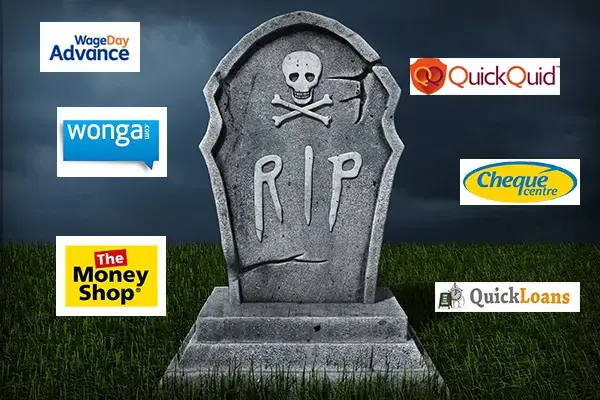
When the UK payday loan cap was announced, Quick Loans handed back its own lending licence. Under the new rules, the numbers simply did not work. We were far from alone. The number of lenders in the market fell sharply. To be fair, the cap was not the only reason: several big lenders were driven out by mis-selling complaints at around the same time, and a long list of well-known names eventually closed. But many others simply looked at the new rules, saw no profit left, and walked away.
The figures the regulator pointed to only told half the story. Payday loan problems fell, because payday loans became much harder to get. But borrowers who still needed money did not disappear. Many moved to loans repaid over slightly more than 12 months, which fall outside the cap altogether.

Meanwhile, the wider picture of problem debt got worse, not better. County court judgments against consumers in England and Wales rose for several years in a row after the cap, passing 1.1 million a year by 2017 and hitting record levels in 2019. By 2018 and 2019, personal insolvencies – bankruptcies, debt relief orders and IVAs – had climbed to their highest level since 2010. Many things drive those numbers, and the cap cannot be blamed for all of it. But it is hard to argue that problem debt was solved when the courts and insolvency figures say otherwise.
A credit card cap could also hurt people who already have cards. If lenders can no longer make money on a customer, the simplest answer is to freeze the card. Borrowers would then have to pay off what they owe, without being able to use their available balance from month to month. For a household that relies on its card to get through to payday, that could be a shock overnight.
The One Upside We Can See
If cards were frozen across the board, people would suddenly have much less to spend. That would be strongly deflationary for the economy, and there is an argument that prices would fall and everyday goods would become cheaper.
But falling spending has a cost of its own. When people stop buying, businesses sell less, and jobs are lost. Cheaper prices are little comfort to someone who has just been made redundant.
Our View
Capping credit card interest at 10% would be almost the same as banning credit cards for the lowest paid in society.
We saw it with the payday loan cap in 2015. Options disappeared, lenders left, and the sector was left with only a handful of choices. Some payday lenders did manage to survive. With a 10% cap on credit cards, we do not believe any would.
Based on our own credit analysis, we estimate that very few people earning less than £40,000 a year would be offered a card at under 10% APR. Above that level, the picture improves a little in line with earnings – but even mainstream reward cards aimed at higher earners typically come with representative APRs of around 30%. A 10% cap would not make cards cheaper for most people. It would simply mean that lenders would only offer them to people who earn well over £40,000 and have a strong credit history or significant assets.
Everyone else – the people who arguably need access to credit the most – would be left with nowhere to go. That is not protecting borrowers. It is shutting them out, and pushing them towards the fraudsters and illegal lenders who are always ready to step in when the legal options run out.
If you are thinking about using a credit card, our guide explains how credit cards work and what APR really means, so you can compare the true cost before you borrow.
Sources
- CNBC – Trump calls for Congress to enact 10% credit card interest rate cap (January 2026)
- PolitiFact – Trump calls for 10% cap, but legislation hasn’t gone anywhere
- Seeking Alpha – Sen. Warren ‘ready to go’ on credit card caps (November 2026)
- US Federal Reserve – Consumer Credit (G.19), including credit card interest rates
- KTVU / Associated Press – Credit card rate caps could save Americans $100B per year, research says (Vanderbilt University study)
- NBC News – Bank of America considers new credit card capped at 10% interest
- Financial Conduct Authority – High-cost short-term credit
- Financial Conduct Authority – High-cost credit review: Feedback Statement FS17/2 (2017)
- Law Gazette – County court judgments hit record levels
- The Insolvency Service – Personal insolvency statistics 2018